What is AEO (Answer Engine Optimization)?
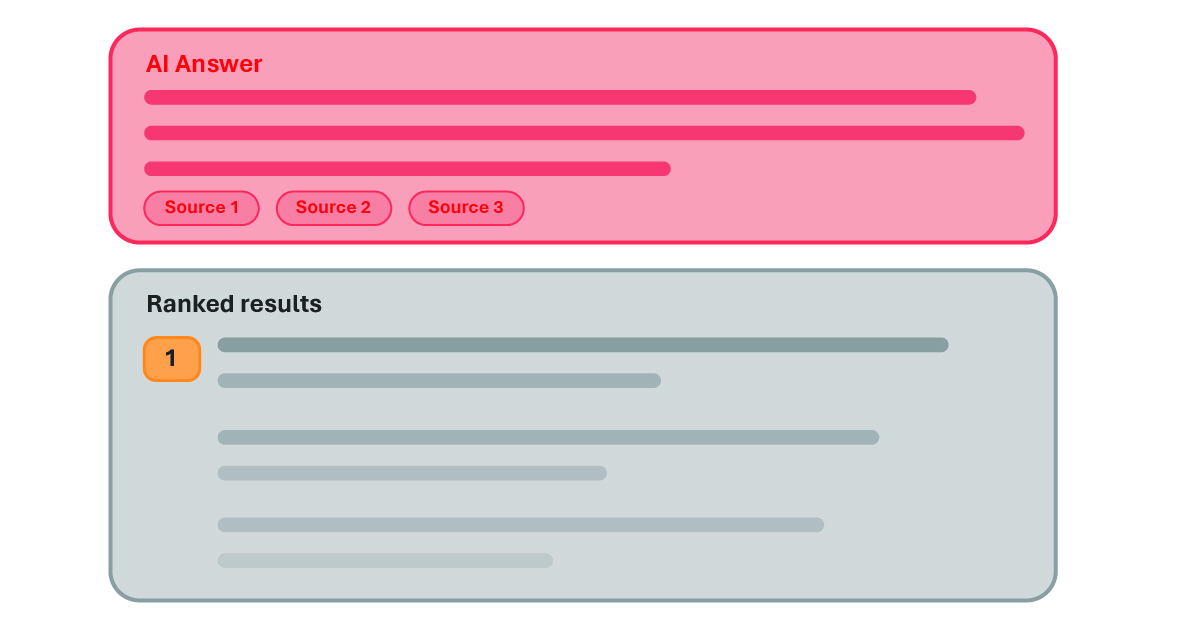
AEO is the practice of structuring content so an AI can extract a clean, correct answer from your page and cite you as the source. When someone searches a how-to or a what-is question and an AI Overview appears, AEO determines whether your brand is one of the sources feeding that box.
It's the closest relative of traditional SEO, but the win condition changed. You're no longer optimizing to earn a click from a list of blue links. You're optimizing to be the paragraph the model lifts.
How AEO actually works
Language models aren't puzzling over your page trying to decode your intent. They're scanning for extractable answers. Make extraction effortless and you get used.
Step one: find the real questions.
Not keywords. Questions, phrased the way a customer would actually phrase them. Sources worth mining:
- Sales calls and consultation notes
- Support tickets and your customer service inbox
- Reddit threads and Facebook groups in your category
- The "People also ask" panel
- Question-research tools like AnswerThePublic or AlsoAsked
- Your paid search query report, converted into question form
The simplest version: if five customers a week ask your team the same thing, that's a page. A dental practice fielding "does a crown hurt?" over and over is being handed a content brief.
Step two: structure for extraction.
- Make the H2 the literal question. Not "Crown Procedure Overview" — "Does getting a crown hurt?"
- Answer immediately underneath, in roughly 40 to 60 words. No windup, no origin story, no brand pitch.
- Put detail, nuance, and context below the answer, not before it.
- Keep sentences short and pages fast.
That one clean opening paragraph is the whole game. Everything else supports it.
Step three: don't let the answer live only on your website.
Models weight corroboration. The same answer appearing in a YouTube explainer, a help doc, a Reddit reply, an industry blog, and a third-party review reinforces that you're the reliable source. A common pattern: the brand mentioned most across sources tends to become the brand mentioned in the answer.
What is GEO (Generative Engine Optimization)?
GEO is the practice of making an AI confident enough to recommend your business by name when someone asks what to buy or who to hire. This is where most SEO strategists get stuck, because it isn't about ranking a page at all.
Picture the difference. Someone asks a search engine "how much does commercial roofing cost?" — that's an AEO question. Someone asks ChatGPT "who should I hire to replace the roof on my warehouse in Columbus?" — that's a GEO question. The second one is worth vastly more, and it's decided by completely different signals.
For a buying question, the model doesn't grab one snippet. It breaks the question into sub-questions, reads across multiple sources, synthesizes an answer in its own words, and names two or three options. GEO is about being one of those names.
What makes AI confident enough to recommend you
Recommending a business is a small credibility risk for the model. It de-risks by looking for specificity. Vague marketing copy is actively harmful here — "affordable, personalized service" gives it nothing to verify.
Replace vagueness with:
- Transparent pricing — real numbers, or at minimum honest ranges
- Explicit use cases — who you're for, and who you're not for
- One deep page per service, not one shallow page covering everything
- Honest comparison content, including where a competitor is the better fit
- Reviews, testimonials, and case studies with names, dates, and measurable outcomes
- Positioning a stranger could repeat accurately in one sentence
Write the content the AI is about to generate
Decision questions produce predictable output: a comparison, pros and cons, cost breakdown, and a "best for this type of person" verdict. If that content already exists on your site in that structure, you're inside the synthesis instead of outside it.
Content that gets pulled in tends to be comprehensive, plainly written, topically clustered, specific and declarative (numbers, tables, dates), genuinely current, and — most valuable of all — built on original data nobody else has.
What is AIO (AI Optimization)?
AIO is the work of making sure AI tools accurately know your business exists, what it does, and that it's legitimate. It's not about any single page. It's the sum of everything about you across the internet, which becomes the model's working memory of your brand.
No amount of on-page craft overcomes an absent or contradictory footprint. If the model isn't confident about who you are, it simply won't say your name.
The three parts of AIO
1. Structured brand data. Give AI clean ingredients to build an accurate profile: schema markup declaring your business type, services, service area, and hours; a substantive About page with founding date, ownership, credentials, and locations; and identical name, address, and phone data everywhere you're listed. Inconsistency is worse than absence — three different phone numbers across three directories creates the exact uncertainty that gets you skipped.
2. Your authority ecosystem. Off-site presence is the proof layer. News mentions, local press, industry awards and certifications, Google and Yelp and vertical-specific review profiles, podcast appearances, inclusion in "best of" roundups, directory listings, and community Q&A participation all count. Reviews and independent mentions now carry weight comparable to or greater than raw backlink counts, because AI trusts consensus over claims. Ten strangers describing your business consistently beats your homepage asserting the same thing.
3. Attention and sentiment. The layer almost nobody addresses. Models respond to evidence that people are actively engaging with you — branded search volume, social mentions, reviews that name you specifically, creators referencing you unprompted. It's uncomfortable but true: a loud credible brand often beats a quiet excellent one.
How can you rank #1 and still lose the customer?
This is the section worth rereading, because it names the three gaps no SEO dashboard will show you.
Gap 1: You're cited, but never chosen
You rank in the top three. You own the featured snippet. Your content is genuinely good. But your pricing page is vague, your service pages are thin, your reviews are sparse, and it isn't obvious who you're for. When someone asks an AI which provider to use, it names your competitor.
On paper your SEO looks excellent. The revenue leaks out at the GEO layer.
Diagnostic: Are you appearing as a source but never as the recommendation?
Gap 2: You have the better business, but AI doesn't understand your brand
Your directory listings disagree with each other. Your review profiles are incomplete. Your About page contradicts what's on your Google Business Profile. Maybe there's outdated third-party information floating around that nobody has corrected.
The model isn't punishing you. It just isn't confident enough to talk about you, so it doesn't. That's an AIO gap, and it silently costs sales.
Diagnostic: Ask an AI to describe your business. Does it hedge, get details wrong, or confuse you with someone else?
Gap 3: Competitors get recommended without ever outranking you
You own page one for your core local term. But when a customer asks a comparison question — one framed around their situation rather than your keyword — the competitor with clearer positioning, stronger reviews, a more substantive About page, and more press gets named instead.
They never beat you in search. They beat you in the layer above search.
Diagnostic: Run your customers' actual buying questions through ChatGPT, Perplexity, Google's AI results, and Claude. Log who appears. Repeat monthly.
Which layer should a business fix first?
Start with AIO. Consistent business data, complete and accurate listings, and an active review profile are the fastest, cheapest wins — and neither AEO nor GEO functions without them. Once AI knows you exist and trusts the picture, layer in GEO's proof content, then AEO's answer-first pages.
Skip AIO and your beautifully structured answers belong to a brand the model can't verify. Skip GEO and you get cited for facts while someone else gets the customer. Skip AEO and you're a trusted brand with nothing extractable to offer.
The bottom line
AEO, GEO, and AIO aren't three names for the same thing. They're three separate places your visibility can fail, and failing at one while excelling at the others produces exactly the situation so many businesses are in right now: strong rankings, shrinking pipeline, no obvious explanation.
If you're not tracking all three, you're not only losing to competitors. You're losing to whatever AI assumes about your business in the absence of evidence — and that's a game you lose by accident.
Curious what AI currently says about your business? Contact Dot The i Creative for an AI visibility audit. We'll show you where you appear, where you don't, and which of the three layers to fix first.