July 7, 2026

The Four Pillars of Marketing: A 2026 Framework

Marketing Insights

|

Dot The i Creative
The Four Pillars of Marketing: A 2026 Framework

By Matt Adams, Founder & CEO of DTi Creative Last updated: May 2026 · ~9 minute read

What are the Four Pillars of Marketing?

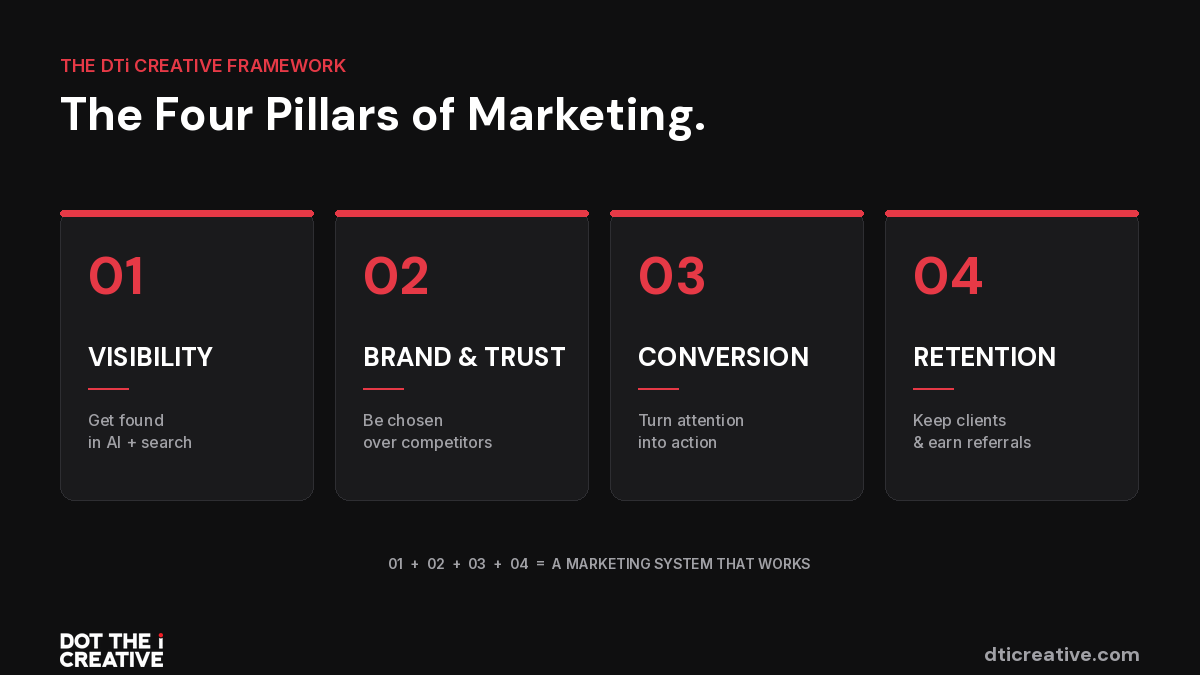
The Four Pillars of Marketing are Visibility, Brand & Trust, Conversion, and Retention & Referrals. Together they form a balanced framework that helps a business get found by new customers, build the trust needed to be chosen, convert attention into action, and turn one-time buyers into repeat business. When all four pillars are working, marketing stops feeling like a stack of disconnected tactics and starts producing predictable growth.

DTi Creative developed the Four Pillars in 2019 as a way to evaluate any client's marketing plan against the four jobs that actually matter. In 2026, the underlying logic still holds — but the tactics inside each pillar have changed dramatically. This guide is the modernized version.

Why we updated the Four Pillars for 2026

The original Four Pillars framework was built around a search-first, social-second world. That world is gone.

Today, customers find businesses through Google, Google Maps, AI Overviews, ChatGPT, Perplexity, Gemini, TikTok, Instagram, YouTube, review platforms, and word of mouth — often before they ever visit a website. According to HubSpot's 2026 AEO research, the most important signals for getting cited by AI engines are structured data, entity clarity, and answer-first content — not the keyword density tactics that defined SEO a few years ago.

That single shift — search splintering into dozens of discovery surfaces — changed what good looks like inside every pillar. The framework needed a refresh, not a replacement.

The 2026 Four Pillars at a glance

Pillar Goal What changed since 2019
01 · Visibility Show up everywhere your customers are already looking Now includes AI search optimization (AI Overviews, ChatGPT, Perplexity), schema markup, and social search alongside traditional SEO and PPC
02 · Brand & Trust Be instantly recognizable, credible, and easy to choose Reviews and reputation are now a ranking factor and a signal AI engines use when recommending businesses
03 · Conversion Turn attention into action without guessing Less emphasis on traffic, more on funnel diagnostics, 5-minute lead response, and first-party tracking
04 · Retention & Referrals Turn customers into repeat business and word of mouth Owned audience (email, SMS, first-party data) is now critical as cookies and third-party tracking shrink

Pillar 1: Visibility

Goal: Show up everywhere your customers are already looking.

Visibility in 2026 means being discoverable across a fragmented landscape — not just ranking on Google. People ask ChatGPT for service recommendations, scroll TikTok for reviews, and check Google Maps before they ever type your name into a search bar. If you're invisible in any of those surfaces, you're invisible to a chunk of your market.

What your business should be doing for Pillar 1

  • Claim and fully optimize your Google Business Profile (GBP). Categories, services, photos, products, weekly posts. This is the single highest-ROI move for any local business seeking to grow their Local SEO.
  • Build technical SEO into your site. Fast loading, mobile-first, clean URLs, an XML sitemap submitted to Google Search Console, and HTTPS everywhere.
  • Add schema markup — Organization, LocalBusiness, FAQPage, Service, and Article schema all help both Google and AI tools understand what you do. Per SEO.com.ph's GEO research, pages with proper schema and explicit definitions get cited more often by ChatGPT and Perplexity.
  • Write content around real customer questions — not keywords you wish you ranked for. The questions your sales team answers daily are gold.
  • Pick 1–2 social platforms and commit. Short-form video is the most efficient discovery format on Instagram, TikTok, and YouTube Shorts.
  • Run measured paid campaigns on Google and Meta when you need to fill the pipeline faster than SEO will.
  • Audit your directory listings (Yelp, Apple Maps, Bing Places, industry-specific sites) for consistent NAP — name, address, phone — across every mention.

How AI search changes Pillar 1

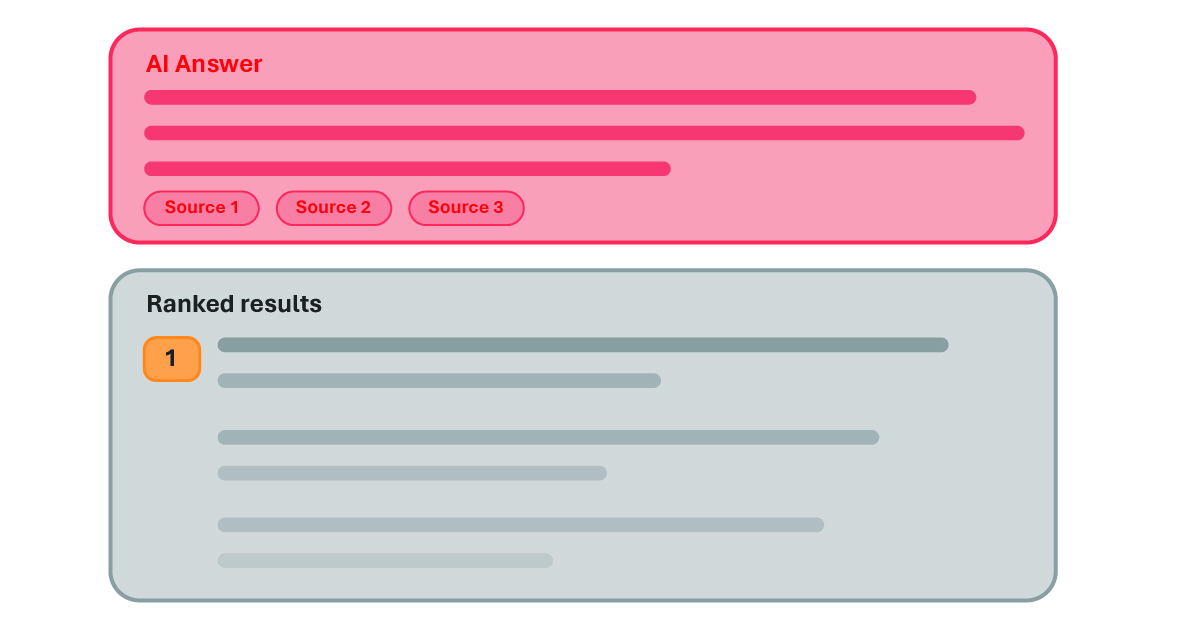
AI engines like ChatGPT, Perplexity, and Google's AI Overviews don't list "blue links" — they synthesize answers and cite sources. To be one of those cited sources, your content needs to be structured for extraction: clear definitions, short focused paragraphs, question-led headings, and schema markup that tells the AI exactly what your page is about.

This is called AEO (Answer Engine Optimization) or GEO (Generative Engine Optimization). It's not a replacement for SEO — it's a layer on top of it. The pages that win in both Google and AI search are the same pages: well-structured, well-sourced, and built around real questions.

Dot The i Creative Services

Get Your Business on the Map!

Climb rankings, grow your reputation, and stand out in local search. See how you stack up with a free Google Business Profile Audit.

Get Your Free GBP Audit

Pillar 2: Brand & Trust

Goal: Make your business instantly recognizable, credible, and easy to choose.

In a world where AI can generate a thousand variations of any logo, ad, or website copy, trust has become the new differentiator. Customers — and the AI tools recommending you — decide in seconds whether you look legitimate. Reviews, consistency, and a clear point of view do the heavy lifting.

What your business should be doing for Pillar 2

  • Nail your positioning in one sentence. Who you serve, what you do, what makes you different. If your team can't recite it, your customers can't either.
  • Build a real review engine. Ask every happy customer, every time, with a one-click link. Aim for fresh reviews monthly — recency matters more than total count for both Google and AI recommendations.
  • Respond to every review — positive and negative. Both AI engines and human prospects use response patterns to judge professionalism.
  • Keep your brand visually consistent across website, ads, email, social, and your Google Business Profile. Inconsistency creates entity ambiguity, which hurts you in AI search.
  • Show your work. Case studies, before/afters, testimonials, certifications, awards, and real team photos all build trust faster than copy alone.
  • Sound like a human. Generic AI-written content reads as generic. Voice and point of view are what make a brand memorable — and citable.

Entity clarity is the new brand consistency. AI engines build a "knowledge graph" of who you are based on every mention of your business across the web. Inconsistent naming ("DTi Creative" vs. "Dot The i" vs. "DTI Creative LLC") creates ambiguity and dilutes authority. Use your exact brand name everywhere — website, schema, social profiles, directories, citations.

Pillar 3: Conversion

Goal: Turn attention into action — without guessing.

Traffic is meaningless if your website, landing pages, and follow-up don't convert. Pillar 3 covers the entire path from first click to closed deal, and using real data to make it better month after month. In short, create a website design that converts.

What your business should be doing for Pillar 3

  • Make the next step obvious. One primary call to action above the fold. Phone number visible on every page. Forms short and frictionless.
  • Build a dedicated landing page for every major offer or paid campaign — don't send paid traffic to your homepage.
  • Set up real tracking. Google Analytics 4, Google Tag Manager, call tracking, conversion tracking on forms, and (for e-commerce) full purchase tracking. You can't improve what you don't measure.
  • Know your conversion rate on every key page and every lead source. If you don't know it, that's the first thing to fix.
  • Test one variable at a time. Headlines, offers, button copy, form length. Small consistent tests compound into massive gains.
  • Respond fast. Per Harvard Business Review's classic lead response study, companies that contact leads within 5 minutes are 9× more likely to qualify them. Automate the instant acknowledgment, then have a human follow up.

Pillar 4: Retention & Referrals

Goal: Turn one-time customers into repeat business and word-of-mouth.

Acquiring a new customer costs 5–7× more than keeping an existing one (Harvard Business Review). The businesses winning in 2026 own their audience — email lists, customer data, community — so they're not dependent on rented attention from ad platforms or social algorithms.

What your business should be doing for Pillar 4

  • Build an email list you actually own. Every customer, every lead, every event attendee. With third-party cookies disappearing, this is the most valuable marketing asset you can build.
  • Send something useful at least monthly. Newsletter, tip, customer story, seasonal offer. Stay top-of-mind without being annoying.
  • Automate the basics. Welcome series for new customers, win-back sequences for lapsed ones, post-purchase follow-ups, and anniversary or birthday messages.
  • Make referrals easy. A simple "send to a friend" link, a small thank-you for both parties, and an explicit ask after every great experience.
  • Track customer lifetime value (CLV), not just acquisition cost (CAC). A customer worth $2,000 over five years is far more valuable than ten one-time $200 customers — but only if your reporting actually shows you that.
  • Show up between purchases. Social content, helpful emails, community involvement — anything that keeps you in mind when the next need arises.

Why the Four Pillars work together (and why missing one breaks the system)

Each pillar reinforces the others. Miss one, and the whole system leaks:

  • Visibility without Trust → you get found, then ignored. Clicks don't convert because nothing signals "safe choice."
  • Trust without Conversion → you're admired but not hired. People like your brand but never take the next step because the path isn't clear.
  • Conversion without Retention → a leaky bucket. You earn customers and lose them, and every month starts at zero.
  • Retention without Visibility → a slow fade. The existing audience ages out and no new customers are coming in to replace them.

This is why piecemeal marketing — a freelancer for ads, a cousin for the website, a SaaS tool for email — almost always underperforms. The Four Pillars give you one connected strategy instead of four disconnected vendors.

Which marketing pillar should I focus on first?

The right starting pillar depends on what's broken in your business right now. Use this quick diagnostic:

Symptom you're experiencing Likely weakest pillar
Not enough leads or inquiries coming in Visibility
Plenty of traffic, but people don't convert Brand & Trust
Leads come in but rarely become customers Conversion
Customers buy once and disappear Retention & Referrals
Heavily dependent on paid ads to fill the pipeline Retention & Referrals (you don't own your audience)
You can't tell what's working Conversion (tracking gap)

Frequently Asked Questions

What is the Four Pillars marketing framework?

The Four Pillars marketing framework is a strategic model that organizes all marketing activity into four jobs: Visibility (getting found), Brand & Trust (being chosen), Conversion (turning attention into action), and Retention & Referrals (keeping customers and earning word-of-mouth). It was developed by DTi Creative in 2019 and updated for 2026 to reflect AI search, owned-audience marketing, and the decline of third-party tracking.

How is the Four Pillars different from the 4 Ps of marketing?

The 4 Ps (Product, Price, Place, Promotion) are a product marketing framework from the 1960s. The Four Pillars are an execution framework for modern digital marketing — they describe what a business should be doing to grow, not how to think about a product's market fit. The two frameworks complement each other; the 4 Ps shape strategy, the Four Pillars shape activity.

Which pillar should a small business focus on first?

For most small and local businesses, Visibility is the right starting point — specifically Google Business Profile optimization and local SEO. It's the highest-ROI move because it brings in qualified inquiries from people who are already searching for what you sell. After that, Retention & Referrals (an email program and review engine) typically delivers the next biggest gain.

Do I need to do all four pillars at once?

No — and trying to do everything at once is the most common mistake we see. Audit honestly, pick the weakest pillar, and fix it first. Once that pillar is working, move to the next. The framework is meant to identify imbalance, not force simultaneous investment.

How does AI search (ChatGPT, Perplexity, AI Overviews) affect the Four Pillars?

AI search reshapes Pillar 1 (Visibility) and amplifies Pillar 2 (Brand & Trust). To get cited by AI engines, your site needs answer-first content, schema markup, clear entity signals (consistent brand naming), and authoritative third-party mentions and reviews. The pillars themselves don't change — but the tactics inside them must evolve.

How long does it take to see results from the Four Pillars approach?

Visibility tactics like Google Business Profile optimization and paid search can produce inquiries within days. SEO and content typically take 3–6 months to produce meaningful organic traffic. Brand, retention, and referral systems take 6–12 months to compound but produce the most durable long-term results. Expect a meaningful difference within 90 days of fixing the weakest pillar.

Can I implement the Four Pillars myself?

Yes — this article is designed as a self-implementation guide. Every action in each pillar is something a small business owner can do without an agency. Most business owners we work with know what they should be doing; they just don't have the time. If that's you, reach out and we can help.

Get a free Google Business Profile audit

Want a head start on Pillar 1 right now? Our LocalRank360 tool will run a free audit of your Google Business Profile — showing you exactly where you rank in your service area, who's beating you, and what's holding you back. No call required, no obligation.

👉 Run your free GBP audit at https://dticreative.com/local-seo-audit

Ready to talk through your Four Pillars?

If you'd rather not figure out which pillar to tackle first on your own, I'm happy to take a look at your business and tell you the honest answer.

About the author

Matt Adams is the Founder and CEO of DTi Creative, a digital marketing agency based in Ohio. He has been helping small and mid-sized businesses build connected marketing systems since 2010, with a focus on Webflow web design, local SEO, and the integrated Four Pillars approach. Connect with Matt at matt@dticreative.com.

DTi Creative square dark background logo
Dot The i Creative

Dot The i Creative (DTi Creative for short) is a full service digital marketing agency offering Search Engine Optimization, PPC & Digital Advertising, Social Media Management, Website Design & Development, Marketing Automation, and Content Creation Services in the Dublin, Ohio and Columbus, Ohio area.

Tags

Conversion

Digital Marketing Services

Digital Advertising

Google My Business Optimization

Google Local

SEO

Lead Generation

Local SEO

Web Design

Backlinks

Digital Ads

Graphic Design

Google AI Mode

Social Media

Social Media Management

PPC

Webflow

Small Business Marketing

Recommended Articles

You Might Also Like

Dot The i Creative

Strategy Driven Design & Results Driven Marketing

Grow your business with custom digital marketing services from Dot The i Creative

Get In Touch
(614) 300-1998